What Bizarre Fashion Statement Linked the 70s Bands 'mud' and the 'skyhooks'?

Photo: Cameron Spencer/Getty Images
Welcome to our new column, Fashion History Lesson, in which we swoop deep into the origin and development of the fashion manufacture's most influential and omnipresent businesses, icons, products and more.
Love it or detest information technology, fast fashion has completely changed how consumers brand purchases, just have you ever wondered how it all began?
The concept of fast manner is widely regarded as being a adequately new concept that originated from brands similar Zara being able to sell trends at tape speed for affordable prices, simply "fast fashion" is actually just a term given to a constantly evolving product system that has been gaining momentum since the 1800s. Read on to find out more about the good, the bad and the bottom-known parts of fast fashion's history.
Related Manufactures
The Problem with Mode Brands That Call Themselves "Sustainable"
Do the H&Chiliad Conscious and Asos Made in Kenya Collections Count as Upstanding Way?
Why Upstanding Fashion is a Feminist Issue
The 1800s
Before the 1800s, about people relied on raising sheep to become wool to spin yarn to weave textile to…. Well, you get the picture. The cycle of mode finally picked up speed during the Industrial Revolution, which introduced new material machines, factories and set up-made clothing, or clothing that is made in bulk in a range of sizes rather than being made to lodge. Commencement patented in 1846, the sewing machine contributed to an extremely rapid fall in the price of habiliment and an enormous increment in the scale of vesture manufacturing. [1]
Exterior of couture houses, localized dressmaking businesses were responsible for making habiliment for middle-class women, while women of lower incomes continued to make their own clothing. [5] Local dressmaking businesses typically included a team of workroom employees, although some aspects of production were outsourced to "sweaters," or people who worked from home for very low wages. [1] Although these types of operations were mostly localized, the practice of using "sweaters" in the 1800s provides a small glimpse of what would eventually become the basis of near mod clothing product.
1900s-1950s
Despite the increasing number of garment factories and sewing innovations, a great deal of clothing product was nevertheless done in the dwelling house or in small workshops throughout the beginning of the 20th century. The material restrictions and more functional styles that were made necessary past World War II led to an increase in standardized production for all habiliment. After becoming accustomed to such standardization, middle-class consumers became more receptive to the value of purchasing mass-produced clothing after the war. [1]
However, it's important to recollect that not everything near innovation is proficient. On March 25, 1911, a burn bankrupt out in New York'due south Triangle Shirtwaist Mill, which claimed the lives of 146 garment workers, many of whom were young, female person immigrants. This also brings to heed recent examples such every bit the 2012 fire at the Tazreen Fashion manufacturing plant in Bangladesh that killed at least 117 people, proving that history often does repeat itself.
1960s-2000s:
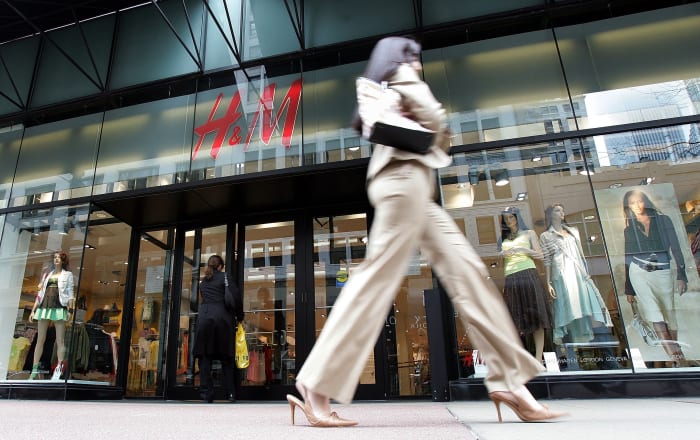
Photo: Tim Boyle/Getty Images
If yous've e'er wondered when fashion trends began moving at a dizzying speed, information technology was the 1960s, as young people embraced cheaply made clothing to follow these new trends and refuse the sartorial traditions of older generations. Soon, mode brands had to notice ways to go on up with this increasing demand for affordable wearable, leading to massive material mills opening beyond the developing world, which allowed the U.S. and European companies to save millions of dollars by outsourcing their labor.
Recommended Articles
Merely, who became the showtime true "fast manner" retailer? The reply is not very articulate, equally many of the companies that we know as leaders in the industry today, including Zara, H&K, TopShop and Primark, started as smaller shops in Europe around the mid-twentieth century. They all focused on affordable trendy clothing, eventually expanded around Europe, and infiltrated the American market old in the 1990s or 2000s. Although each make emphasizes their humble ancestry and meteoric rises, it's hard to make up one's mind who influenced whom. The rapid growth that defines these brands today goes hand-in-hand with toll-cutting measures, and not many companies are eager to celebrate or detail the controversial switch to overseas sweatshop labor.
Technically, H&M is the longest running of these retailers, having opened every bit Hennes in Sweden in 1947, expanding to London in 1976 and eventually reaching u.s.a. in 2000. Co-ordinate to the New York Times, founder Erling Persson drew inspiration for his store from visiting loftier-book retail establishments in the U.S. after WWII. [2]
Zara founder Amancio Ortega opened his first store in Northern Spain in 1975, supposedly using the aforementioned principle that it follows today: make speed the driving force. When Zara came to New York at the commencement of 1990, the New York Times used the term "fast fashion" to describe the shop'due south mission, declaring that information technology would merely take 15 days for a garment to go from a designer'due south brain to being sold on the racks. [four]
Before the arrival of these global retail giants, American consumers on the hunt for wear that was trendy-even so-affordable had to get to the mall and store at trend-driven teen stores such equally Moisture Seal, Express and American Eagle. Although these tin can be seen equally the American precursors to the fast fashion empire, these mall stores were unable to churn out new clothing trends well-nigh equally fast as what we've come to expect these days. The inability to keep stores stocked with a huge multifariousness of new merchandise in the bridge of weeks has led to their rapid demise. However, America is besides home to 1 of the fastest growing fast mode retailers, Forever 21, which opened as a pocket-size store in Los Angeles back in 1984.
Although it is hard to pinpoint the origins of fast fashion every bit we know it today, it'due south easy to understand how the phenomenon caught on. In the late 1990s and early 2000s, it became increasingly more acceptable (and desirable) to flaunt one's love for low-price mode, and seen as specially savvy to be able to mix high and low manner with aplomb. When the first H&Yard location in the U.Due south. opened in April 2000, the New York Times wrote that the retailer had arrived at the right time every bit consumers had just recently become more likely to hunt for bargains and dismiss department stores, stating that information technology was now "chichi to pay less." [3]
Fast fashion brands recently received a high profile co-sign, every bit leading ladies Kate Middleton and Michelle Obama take been spotted in dresses from retailers like Zara and H&Thou. The embrace of "disposable fashion" by such prominent women would have been unheard of simply a few decades agone, but speaks to the "democratization of manner" enabled past mass product, allowing more people to communicate through clothing regardless of their social and economic backgrounds.
TODAY
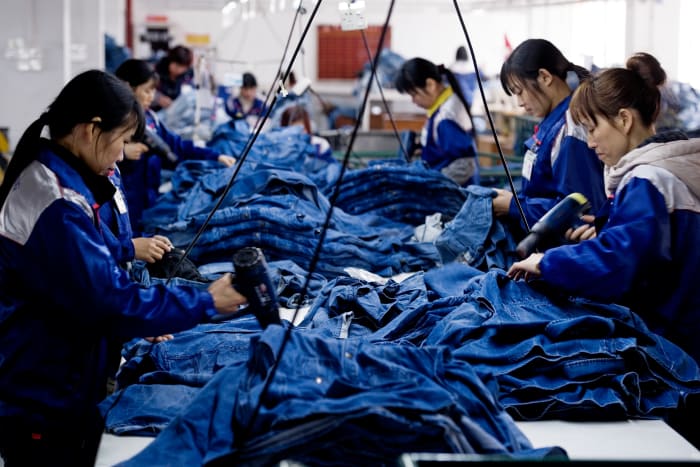
Photo: Lucas Schifres/Getty Images
Considering the long path from spinning 1'south own yarn to globalized production, it seems amazing that nosotros now alive in an age when y'all can buy a garment on your phone just moments after information technology first walked downwardly the track.
Of form, we must also acknowledge that there are major problems with our current fashion system, such as unjust labor practices and catastrophic amounts of waste material. In an industry that has historically been focused on moving faster, information technology's time to consider slowing down, at least enough to be more mindful of the purchases that we make. Thankfully, that doesn't mean that we accept to get back to making our ain clothes from scratch anytime soon.
Sources non linked:
[one] Breward, Christopher. Oxford History of Art: Fashion. Oxford: Oxford Academy Press, 2003.
[two] "Erling Persson, 85; Founded Article of clothing Concatenation."New York Times. November 1, 2002: C13.
[3] La Ferla, Ruth. "'Cheap Chic' Draws Crowds on 5th Ave."New York Times. April 11, 2000: B11.
[4] Schiro, Anne-Marie. "Ii New Stores That Prowl Fashion's Fast Lane."New York Times. December 31, 1989: 46.
[v] Steele, Valerie (ed.). Encyclopedia of Clothing and Fashion. New York: Charles Scribners & Sons, 2004.
Desire the latest fashion industry news first? Sign upwardly for our daily newsletter.
0 Response to "What Bizarre Fashion Statement Linked the 70s Bands 'mud' and the 'skyhooks'?"
Post a Comment