Street Fashion on Park Avenue Nyc
Route map:
KML is from Wikidata
| Quaternary Avenue, Union Square East, Park Avenue South | |||
 Looking south from 52nd Street, facing the MetLife Building and Helmsley Building in the background with St. Bartholomew'due south Episcopal Church and Waldorf Astoria New York to the left | |||
| Former name(s) | 4th Avenue | ||
|---|---|---|---|
| Owner | Urban center of New York | ||
| Maintained by | NYCDOT | ||
| Length | ten.9 mi[1] [2] [3] (17.5 km) | ||
| Location | Manhattan and The Bronx, New York Urban center | ||
| Southward terminate | Astor Place in Cooper Square | ||
| Major junctions | Park Avenue Tunnel and Viaduct in East Midtown Harlem River Drive in Due east Harlem Harlem River Drive in Due east Harlem | ||
| North end | Third Artery in Fordham | ||
| East | Lexington Avenue | ||
| Due west | Madison Artery | ||
| Construction | |||
| Commissioned | March 1811 | ||
Park Avenue is a wide New York City boulevard[4] which carries n and southbound traffic in the borough of Manhattan. For most of the road'south length in Manhattan, it runs parallel to Madison Avenue to the west and Lexington Avenue to the east. Park Avenue's entire length was formerly called Fourth Avenue; the title still applies to the section betwixt Cooper Foursquare and 14th Street.[5] The avenue is called Wedlock Square East between 14th and 17th Streets, and Park Artery South betwixt 17th and 32nd Streets.
History [edit]
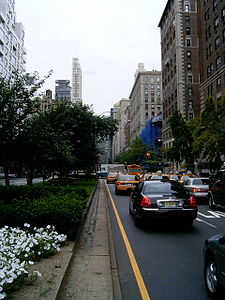

The railroad tunnel in 1941
Early years and railroad structure [edit]
The entirety of Park Artery was originally known as Fourth Avenue and carried the tracks of the New York and Harlem Railroad starting in the 1830s.[6] The railroad originally ran through an open up cut through Murray Hill, which was covered with grates and grass between 34th and 40th Street in the early 1850s. A section of this "park" was later renamed Park Avenue in 1860.[seven] Park Avenue's original southern terminus was at 34th Street, and the newly renamed Park Avenue was given its own house-numbering system separate from that of Fourth Artery. The address ane Park Avenue was assigned to a house at 101 East 34th Street, at the northeast corner of Park Avenue and 34th Street.[viii]
The Harlem Railroad was later on incorporated into the New York Key Railroad, and a terminal for the New York Central at 42nd Street, the Grand Cardinal Depot, opened in 1871.[9] : 3 But the tracks laid to the new final proved problematic. There were originally no class-separated crossings of the railroads between 42nd and 59th Streets.[10] As such, they required railroad crossings along 4th Avenue, which resulted in frequent accidents; seven people died inside 12 days of the Hudson River Railroad'south move to Grand Fundamental.[xi]
In 1872, shortly afterwards the opening of Grand Fundamental Depot, New York Primal owner Cornelius Vanderbilt proposed the 4th Avenue Improvement Projection.[9] The tracks between 48th and 56th Streets were to be moved into a shallow open cutting,[12] while the segment between 56th and 97th Streets, which was in a rock cut, would be covered over.[9] [a] Later on the improvements were completed in 1874, the railroads, approaching Grand Central Depot from the north, descended into the Park Avenue Tunnel at 96th Street and continued underground into the new depot.[nine] Equally part of the projection, 4th Avenue was transformed into a boulevard with a median strip that covered the railroad's ventilation grates.[14] [xv] [9] : 4 Viii footbridges crossed the tracks betwixt 45th and 56th Streets, and there were also vehicular overpasses at 45th and 48th Streets.[9] : 4 The boulevard north of Chiliad Central was renamed Park Artery in 1888.[16]
Chiliad Cardinal and Concluding Metropolis [edit]
A fatal collision between two trains occurred under Park Avenue in 1902, in part because the smoke coming from the steam trains obscured the signals.[17] [18] The New York country legislature afterward passed a law to ban all steam trains in Manhattan.[xix] By December 1902, every bit role of an understanding with the city, New York Central agreed to put the approach to Grand Central Station from 46th to 59th Streets in an open up cut under Park Avenue, and to upgrade the tracks to accommodate electric trains. Overpasses would be built beyond the open cut at almost of the cross-streets.[20] The new electrical-train terminal, Yard Key Last, was opened in 1913.[21]
Subsequently the electric trains were cached secret, the area effectually Park Artery in the vicinity of Grand Central was developed into several blocks worth of prime real manor called Terminal City. Stretching from 42nd to 51st Streets betwixt Madison and Lexington Avenues, it came to include the Chrysler Building and other prestigious part buildings; luxury apartment houses along Park Avenue; and an array of high-terminate hotels that included the Marguery, Park Lane, and Waldorf Astoria.[22] In 1929, New York Central congenital its headquarters in a 34-story building (now called the Helmsley Building), straddling Park Avenue north of the final.[23]
The Park Artery Viaduct reroutes Park Avenue effectually Grand Cardinal Terminal between 40th and 46th Streets, allowing Park Avenue traffic to traverse around the edifice and over 42nd Street without encumbering nearby streets.[24] The western (now southbound) leg of the viaduct was completed in 1919,[25] merely congestion developed presently after the viaduct'due south opening, then an eastern leg for northbound traffic was added in 1928.[24]
Afterwards years [edit]
The developer Henry Mandel acquired the lots on the eastern side of 4th Avenue between 32nd and 33rd Street in 1923 under the name "One Park Avenue Corporation". To ensure his corporate name was accurate, Mandel asked the New York City Board of Aldermen to motion Park Avenue's southern terminus to 32nd Street.[eight] The change went into event on Dec ane, 1924, and address numbers along Park Avenue were changed accordingly.[26] The previous house numbered 1 Park Avenue was occupied past Martha Bacon, widow of diplomat Robert Bacon, who led the opposition to the renumbering.[27] The Board of Aldermen summarily overturned the name change,[8] but Mayor John Hylan vetoed the move in April 1925.[28] This prompted Bacon to appeal the decision to the New York Supreme Court, Appellate Division, which overturned Hylan'south veto in November 1927, on the basis that the extension of Park Avenue to 32nd Street had been made for the benefit of a developer.[26] [29] Mandel's development at 32nd Street was thus known equally 461–477 Fourth Avenue, and the developers of that building sued to reverse the appelate ruling.[8] The New York Court of Appeals, the state'due south highest courtroom, reversed the appellate ruling in February 1928.[30] [31] Salary contemplated bringing up the matter with the Us Supreme Court,[32] but she ultimately relented, changing her address to "Park Avenue at 34th" by 1930.[8]
In 1927, the medians on Park Avenue north of K Central were trimmed to add ane lane of traffic in each direction. This project eliminated the pedestrian path on the medians, as they became much narrower. The median was extended by one block from 96th Street to 97th Street in 1941, creating the simply remaining median on Park Avenue with a pedestrian path and seating.[33] In the 1920s the portion of Park Artery from G Central to 96th Street saw all-encompassing flat building construction. This long stretch of the artery contains some of the about expensive real manor in the world. Real estate at 740 Park Avenue, for case, sells for several thousand dollars per square foot.[34]
In October 1937, a function of the Murray Hill Tunnel was reopened for road traffic. Efforts to promote a 1000 Park Artery Expressway to Grand Concourse in the Bronx were unsuccessful.[35]
A tradition was introduced in 1945 as a memorial to American soldiers killed in action, whereby Christmas trees are placed in the median and lit upwards on the first Sunday in December at Brick Presbyterian Church.[36] On May v, 1959, the New York Metropolis Quango voted 20–one to change the name of Fourth Avenue between 17th and 32nd Streets to Park Avenue Southward. The renaming, forth with a ban on overhanging signs forth the newly renamed Park Avenue Due south, was intended to improve the character of the avenue.[37] Different with the earlier renamings of Park Avenue, the address numbers of Park Avenue South continued from those on the remaining section of Fourth Avenue.[eight] The Pan Am Building (now MetLife Building), in between the Park Avenue Viaduct'southward legs north of M Primal Terminal, was opened in 1963.[38]
On March 12, 2014, two apartment buildings near 116th Street, 1644 and 1646 Park Avenue, were destroyed in a gas explosion. 8 people were killed and many others were injured.[39]
Route [edit]
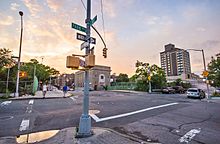
Manhattan [edit]
The road that becomes Park Avenue originates at the Bowery. From Cooper Square at 8th Street to Union Foursquare at 14th Street, it is known as Fourth Artery, a 70-foot-wide (21 m) road carrying northbound traffic. At 14th Street, it turns slightly northeast to align with other avenues drawn up in the Commissioners' Programme of 1811. From 14th Street to 17th Street, it forms the eastern boundary of Union Foursquare and is known equally Spousal relationship Foursquare Due east; its southbound lanes merge with Broadway s of 15th Street, and the thoroughfare divides into 2 singled-out portions in the one-cake section between 14th and 15th Streets. From 17th Street to 32nd Street, it is known every bit Park Avenue Southward.[2] Address numbers on Park Avenue South are a continuation of those on Fourth Artery;[40] for case, 225 Park Avenue Southward was originally known as 225 4th Avenue.[41]
Higher up 32nd Street, for the remainder of its altitude, it is known as Park Artery, a 140-pes-wide (43 thou) boulevard.[2] The address numbers for Park Avenue are reset to a higher place 32nd Street;[forty] for example, the address one Park Artery would unremarkably have been numbered 461 Quaternary Avenue.[8] Betwixt 33rd Street and 40th Street, the leftmost northbound lane descends into the Murray Colina Tunnel. N of 40th Street, the centre lanes of Park Avenue rising onto an elevated structure that goes around Grand Central Terminal and the MetLife Building (formerly the Pan Am Building), conveying each direction of traffic on contrary sides of the buildings. The bridge, one of ii structures in Manhattan known equally the Park Artery Viaduct, returns to ground level at 46th Street after going through the Helmsley Building (also referred to as the New York Fundamental Building or 230 Park Avenue).[2] The IRT Lexington Avenue Line runs under this portion of the street. Once the line reaches Chiliad Central–42nd Street, information technology shifts east to Lexington Avenue.

Park Avenue northbound by 51st Street in Midtown Manhattan
Equally Park Artery enters Midtown north of Grand Central Concluding, information technology is distinguished by many drinking glass-box skyscrapers that serve as headquarters for corporations and investment banks such as Société Générale, JPMorgan Chase at 270 Park Avenue and 277 Park Avenue, UBS at 299 Park Avenue, Citigroup at 399 Park Avenue, Colgate-Palmolive, and MetLife at the MetLife Building.[2] Prior to July 2010, the 11 intersections between 46th Street and 56th Street lacked the city'due south usual pedestrian crossing signals and overhead gantry-mounted traffic lights, because the railroad tunnel ceiling, which is also the street, was not thick enough for their poles' foundations. (These intersections did, all the same, have upright pole-mounted traffic lights prior to 2010, merely at that place were no pedestrian signals. After 2010, standard gantry-mounted traffic lights and pedestrian "inaugural" signals were installed.)[42] [43]
From 47th to 97th Streets, the tracks for Metro-Northward Railroad'southward Park Avenue principal line run in the Park Artery Tunnel underneath Park Artery. At 97th Street, the tracks come above ground, rising onto the other Manhattan construction known equally the Park Avenue Viaduct. The starting time street to pass under the viaduct is 102nd Street; from there to the Harlem River the railroad viaduct runs down the middle of Park Artery. Park Avenue in Manhattan ends north of 132nd Street, with connections to the Harlem River Bulldoze.[2]
The flowers and greenery in the median of Manhattan's Park Artery are privately maintained, by the Fund for Park Avenue. The begonia was specifically called by the Fund's gardeners because at that place is no automatic watering system and the floral variety is resilient nether hot sun rays.[44]
The Bronx [edit]
The artery is connected on the other side of the river in the Bronx. In the Bronx, Park Avenue begins at E 135th Street in the Mott Haven neighborhood. The unabridged avenue is divided past Metro-North'due south own right of manner in the borough. Between East 135th Street to Due east 173rd Street, Park Avenue is one manner only in either direction in most sections. Due north of East 173rd Street it is a 2 style avenue continuing to Fordham Plaza where information technology ends.[3]
Businesses [edit]

The following institutions are either headquartered or have significant business presences on Park Artery:
- Arconic
- American Airlines at ii Park Ave.
- Americas Club
- Asia Society
- Bankers Trust
- The Blackstone Group at 345 Park Ave.
- Bristol Myers Squibb
- British Airways at two Park Ave.
- Cantor Fitzgerald at 499 Park Ave.
- Citigroup at 399 Park Ave.
- Colgate-Palmolive at 300 Park Ave.
- Council on Foreign Relations
- Credit Suisse at 324 Park Ave.
- C. V. Starr at 90 Park Ave.
- Deutsche Banking concern
- Digitas
- Environmental Defense Fund
- EXL Service
- FactSet at xc Park Ave.
- Ferrari
- Heineken International
- Hilb, Rogal & Hobbs Co.
- Hachette Book Group U.s.a. at 237 Park Ave.
- Houlihan Lokey at 245 Park Ave.
- Hunter College
- JPMorgan Chase & Co. at 270 Park Ave.
- KPMG
- Leucadia National
- Major League Baseball
- Maserati
- Mercedes-Benz
- MetLife at 200 Park Ave.
- M&T Depository financial institution
- Mutual of America at 320 Park Ave.
- The National Football game League
- Needham & Company
- New York Life
- Oneworld at ii Park Ave.
- Piper Jaffray at 345 Park Ave.
- Reed Elsevier
- Sanofi-Aventis
- Seligman
- Société Générale
- Tata Consultancy Services
- Vivendi SA
- UBS at 299 Park Ave.
- The Waldorf-Astoria Hotel at 301 Park Ave.
Notable structures [edit]
In north-s gild:[2]
- Daryl Roth Theatre
- 44 Wedlock Foursquare
- Everett Building, 200 Park Avenue South
- W New York Union Foursquare, 201 Park Avenue South
- 225 Park Avenue South
- Church building Missions House, 281 Park Artery Due south
- United Charities Edifice, 287 Park Artery S
- 300 Park Avenue Due south
- Metropolitan Life North Building, 324 Park Avenue Due south
- New York Life Building, 364–378 Park Avenue South
- 2 Park Avenue –designed by Ely Jacques Kahn
- 3 Park Avenue
- Scandinavia Firm, 58 Park Avenue
- Pershing Square Building, 125 Park Artery
- Thousand Cardinal Terminal (actually in Park Avenue, betwixt the Park Avenue Viaduct's two roadways)
- MetLife Building, 200 Park Avenue
- Helmsley Edifice, 230 Park Avenue
- 101 Park Avenue
- 245 Park Artery
- 270 Park Avenue
- 277 Park Artery
- 299 Park Avenue
- Waldorf Astoria New York, 301 Park Avenue
- St. Bartholomew'southward Episcopal Church
- 345 Park Avenue
- Racquet and Tennis Guild, 370 Park Avenue
- Park Avenue Plaza
- Seagram Building, 375 Park Avenue –designed by Mies van der Rohe
- Lever House, 390 Park Artery –designed by Gordon Bunshaft
- 399 Park Avenue
- 425 Park Avenue
- 432 Park Avenue
- Ritz Belfry, 465 Park Artery
- Halstead Property, 499 Park Avenue
- 500 Park Avenue
- Trump Park Avenue, 502 Park Avenue
- Primal Presbyterian Church building, 593 Park Avenue
- 620 Park Avenue
- Seventh Regiment Arsenal, 643 Park Avenue
- 655 Park Avenue
- Harold Pratt House, 58 E 68th Street (corner of Park Avenue)
- Park Avenue Houses
- Percy R. Pyne House, 680 Park Artery (now the Americas Society)
- Oliver D. Filley House, 684 Park Avenue (at present the Queen Sofía Castilian Found)
- William Sloane Firm, 686 Park Avenue (now the Italian Cultural Institute of New York)
- Henry P. Davison House, 690 Park Avenue (now the Italian Consulate Full general)
- Asia Society, 725 Park Avenue
- 740 Park Avenue
- 778 Park Artery
- 970 Park Avenue
- Church building of St. Ignatius Loyola, 980 Park Avenue
- 1000 Park Artery
- Park Artery Christian Church, 1010 Park Artery
- Brick Presbyterian Church building, 1140 Park Avenue
Transportation [edit]
Track transit [edit]
Metro-North Railroad's Grand Cardinal Last, serving the Harlem Line, Hudson Line, and New Haven Line, is at 42nd Street and Park Avenue. The MNR's Park Avenue main line runs along Park Avenue in both boroughs between Grand Central and Fordham station, with stations in between at 125th Street, 162nd Street, and Tremont Artery.[45]
The New York Urban center Subway'due south adjacent Grand Primal–42nd Street station serves the 4, five, 6, <6>, vii, <7>, and S trains. The IRT Lexington Avenue Line additionally runs under Park Avenue and its extensions from 41st to 8th Streets. The 33rd Street, 28th Street, 23rd Street, and Astor Place stations are served by the 6 and <6> trains, while the 14th Street-Union Foursquare station is served past the 4, five, 6, <half-dozen>, L, N, Q, R, and W trains.[46]
Double-decker service [edit]
The southbound M98 Express runs on Park Artery between Harlem River Bulldoze and 120th Street, stopping at the Harlem-125th Street station. The northbound M1, M2, and M3 serve Park Avenue between 8th Street and 25th Street.[47] The southbound SIM1, SIM3, SIM4, SIM33, X27 and X28 limited bus routes serve Park Avenue during off-height hours.[48] [49] No buses run along Park Avenue in the Bronx, although Fordham Plaza Double-decker Terminal is located at the northern end of the road.[50]
In popular civilisation [edit]
- In the 2020 miniseries The Undoing
- In the 2012 motion picture The Avengers, the climax takes place on the Park Avenue Viaduct.
- In the Boob tube serial The Odd Couple, Felix Unger and Oscar Madison live at 1049 Park Avenue.
- In the Tv set serial Diff'rent Strokes, Phillip Drummond, with his girl, Kimberly and adopted sons, Willis and Arnold Jackson alive at 697 Park Avenue.
- In The Simpsons episode "East-I-E-I-D'oh", Homer is ridiculed by 2 farmers exterior Sneed's Feed & Seed (Formerly Chuck'due south) for having a "Park Avenue manicure". Homer responds by saying "I'm sorry, I believe in good grooming".
- The PBS documentary Park Avenue: Money, Ability and the American Dream sheds light on the gap between the impoverished people living on Park Avenue in the Southward Bronx and the extremely wealthy living at 740 Park Avenue in Manhattan.
- In the multi-platinum 1989 hit single "Youth Gone Wild" past American band Skid Row, Park Avenue is mentioned in the lyrics: "I said 'Hey man, at that place'south something that y'all oughta know. / I tell ya Park Avenue leads to Skid Row.'"
- The stage and film musical How to Succeed in Business Without Actually Trying takes place in the fictional "Park Avenue part building of Earth Wide Wicket Company, Inc."
- General Motors borrowed the name of the street for the Buick Park Avenue, a large luxury sedan that was produced first every bit the premium trim line for the Buick Electra from 1977 to 1990, and equally a standalone model from 1991 to 2005.
- In the intro to the late 1960s - early 1970s TV show Green Acres, Eva Gabor's character sings "Darling I dearest y'all, but give me Park Avenue!", where she lived earlier moving to rural Hooterville with her husband, the lawyer-turned-farmer.[51]
- The song "Puttin' On the Ritz", from the moving-picture show Blue Skies (1946), refers to affluent people strutting "upward and down Park Avenue".
- In the 2017 video game Sonic Forces, one of the main stage takes identify on Park Avenue, the stage re-imagined equally a war zone.
- In the second flavour of Riverdale, ane of the main characters from the show, Veronica Lodge is said to accept lived on Park Avenue when she was back in New York City.
- In an episode in the second flavor of Seinfeld, "The Chinese Eatery", 1 character that cuts in front of the chief characters Jerry, Elaine, and George at a eating house in Manhattan is said to alive there, implying that he'south incredibly wealthy and deserving of the special treatment.
Gallery [edit]
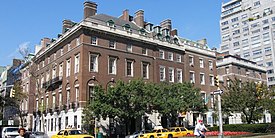
-

10 Park Avenue, at the corner of East 34th Street
-
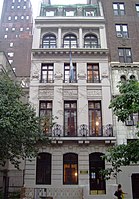
The Adelaide L. Townsend Douglas House, currently the Guatemalan U.N. Mission at 57 Park Avenue, between Eastward 37th and 38th Streets
See also [edit]
- List of most expensive streets by city
References [edit]
Explanatory notes
- ^ The line entered fully enclosed brick tunnels betwixt 67th and 71st Streets, and between 80th and 96th Streets. The remainder of this segment was located in a "beam tunnel" structure, which were mostly open-air, except where cross-streets traversed the cut on steel-beam bridges.[13]
Citations
- ^ Google (September 10, 2015). "Fourth Avenue and Wedlock Foursquare Eastward" (Map). Google Maps. Google. Retrieved September 10, 2015.
- ^ a b c d east f g Google (September 10, 2015). "Park Avenue (Manhattan)" (Map). Google Maps. Google. Retrieved September ten, 2015.
- ^ a b Google (September 10, 2015). "Park Avenue (The Bronx)" (Map). Google Maps. Google. Retrieved September 10, 2015.
- ^ Grayness, Christopher (May 12, 2002). "Streetscapes:903 Park Avenue, at 79th Street". The New York Times.
- ^ New York City Geographic Information Systems map
- ^ Grayness, Christopher (March three, 2013). "Earlier There Was a 'Grand' in Central". The New York Times . Retrieved October fifteen, 2015.
- ^ Gray, Christopher (July 24, 2011). "Putting the Park in Park Avenue". The New York Times . Retrieved October 15, 2015.
- ^ a b c d e f chiliad Gray, Christopher (November seven, 2008). "History Lessons by the Numbers". The New York Times. ISSN 0362-4331. Retrieved July 20, 2021.
- ^ a b c d e f Fitch, James Marston; Waite, Diana South. (1974). One thousand Central Concluding and Rockefeller Center: A Celebrated-critical Estimate of Their Significance. Albany, New York: The Sectionalization.
- ^ "THE RAILROAD TRAP.; Another Mean solar day'south Scenes at the One thousand Central Depot". The New York Times. November 18, 1871. Retrieved December four, 2018.
- ^ "RAILROAD ABUSES.; Official Investigation into the Thousand Central Depot Nuisance. Scenes and Incidents at the Crossings Yesterday.Search for the Missing Dead Only Ane Out of the Seven Said to be Killed However Found The Coroners and the PoliceUtterly in the Nighttime. The Dangers that Centre Around the New Vanderbilt Depot What the Officials Say Minor Inconveniences". The New York Times. October 1, 2018. Retrieved December iv, 2018.
- ^ "The Country Capital; Rapid Transit of Railroad Bills in the Assembly". New York Herald. April 24, 1872. p. xiii. Retrieved December vi, 2018 – via newspapers.com.

- ^ Robins, A.W.; New York Transit Museum (2013). 1000 Key Terminal: 100 Years of a New York Landmark. ABRAMS. p. 85. ISBN978-ane-61312-387-4 . Retrieved December 6, 2018.
- ^ Reitano, J. (2018). The Restless City: A Curt History of New York from Colonial Times to the Present. Taylor & Francis. p. 278. ISBN978-i-134-81048-2 . Retrieved Dec 4, 2018.
- ^ "Grand Central Terminal". E Side Access in New York, Queens, and Bronx Counties, New York, and Nassau and Suffolk Counties, New York: Ecology Bear on Statement. East Side Access in New York, Queens, and Bronx Counties, New York, and Nassau and Suffolk Counties, New York: Environmental Bear on Statement. 2001. p. 3. Retrieved December 4, 2018.
- ^ Grey, Christopher (March 17, 2002). "Streetscapes: 709 and 711 Park Avenue, Between 69th and 70th Streets; When Park Ave. Was 4th, and Not Socially Correct". The New York Times . Retrieved October xv, 2015.
- ^ "FIFTEEN KILLED IN REAR Cease Standoff; Trains Crash in Darkness of Park Avenue Tunnel. TWO SCORE ARE INJURED Engineer Disregards or Fails to Come across Signals. LOCOMOTIVE Cached IN Auto Firemen Cut Their Mode Into the Wreck and Climb Over the Hot Boiler to the Aid of the Wounded -- Heroic Acts of Rescuers and Rescued -- Survivors and Others Tell Thrilling Stories of Their Experiences". The New York Times. January 9, 1902. Retrieved Dec ten, 2018.
- ^ "Fifteen Killed, Thirty-Six Injure". New-York Tribune. January ix, 1902. p. ane. Retrieved December 10, 2018 – via newspapers.com.
- ^ Sprague, J. L.; Cunningham, J. J. (2013). "A Frank Sprague Triumph: The Electrification of G Central Terminal [History]". IEEE Power and Energy Mag. Vol. 11, no. 1. Establish of Electric and Electronics Engineers (IEEE). pp. 58–76. doi:10.1109/mpe.2012.2222293. ISSN 1540-7977.
- ^ "NEW YORK Central TO ACCEPT CITY'South PLANS; Station, Tunnel, and Other Improvements to Cost $25,000,000. Park Artery to be Opened, Bridges Built at Cantankerous Streets, Electricity Introduced, and Grade Crossings Abolished". The New York Times. December 27, 1902. Retrieved Dec 10, 2018.
- ^ Maranzani, Barbara. "Grand Central Concluding: An American Icon". History.com . Retrieved February two, 2018.
- ^ Greyness, Christopher (August 19, 2010). "Covering Its Tracks Paid Off Handsomely". The New York Times . Retrieved December 10, 2018.
- ^ "Park Avenue, Interrupted". The New York Times. December 21, 2014. Retrieved December eight, 2018.
- ^ a b "New Viaduct Thoroughfare Relieves Park Avenue Traffic Congestion; Result of Many Years' Piece of work" (PDF). The New York Times. September 2, 1928. p. Real Manor, Page 123. Retrieved December 7, 2018.
- ^ "Link Upward Park Av. to Ease Congestion". The New York Times. April 17, 1919. Retrieved December seven, 2018.
- ^ a b "Appellate Courtroom Scores Officials in Park Ave. Suit". The Brooklyn Daily Eagle. November iv, 1927. p. 24. Retrieved July 20, 2021.
- ^ "Number 1 Park Avenue". The New York Times. February x, 1925. ISSN 0362-4331. Retrieved July 20, 2021.
- ^ "Hylan Veto Halts Park Ave. Modify". The Yonkers Herald. April 23, 1925. p. eight. Retrieved July xx, 2021.
- ^ "Salary'southward Widow Blocks Trade on Park Avenue". Press and Sun-Bulletin. Nov five, 1927. p. 16. Retrieved July 20, 2021.
- ^ "Mrs. Salary's Long Fight to Retain 'one Park Ave.' as Address Is Finally Lost". The Brooklyn Daily Eagle. February xix, 1928. p. 7. Retrieved July 20, 2021.
- ^ Times, Special to The New York (Feb 15, 1928). "Mrs. Bacon Loses Fight for No. 1 Park Avenue; Appeals Court Upholds Renumbering by City". The New York Times. ISSN 0362-4331. Retrieved July 20, 2021.
- ^ "Mrs. Salary May Fight On; Reported Ready to Take No. 1 Park Artery Battle to Supreme Court". The New York Times. February 16, 1928. ISSN 0362-4331. Retrieved July twenty, 2021.
- ^ Kadinsky, Sergey (October 24, 2017). "Park Avenue's Hidden History". Forgotten-NY . Retrieved October 25, 2017.
- ^ Rogers, Teri Karush (October 9, 2005). "Peeking Behind the Gilded Walls of 740 Park Ave". The New York Times . Retrieved August fifteen, 2007.
- ^ "Park Artery Limited Highway (NY 22, unbuilt)". Nycroads.com. February 14, 1935. Retrieved Oct eight, 2012.
- ^ Kilgannon, Corey (December 3, 2010). "Park Ave. Christmas Lights Go Upwards, and Xiao Ye Closes". The New York Times.
- ^ Bennett, Charles G. (May vi, 1959). "Sign Ban Is Voted on Two Avenues". The New York Times. p. 41. Retrieved July 31, 2010.
- ^ Gray, Christopher (October seven, 2001). "Streetscapes/The MetLife Building, Originally the Pan Am Building; Critics In one case Called It Ugly; Now They're Not Certain". The New York Times . Retrieved September 30, 2015.
- ^ Santora, Marc & Rashbaum, William K. "Rescue Effort in Due east Harlem Yields Only More Victims". New York Times . Retrieved March thirteen, 2014.
- ^ a b "NYCityMap". NYC.gov. New York City Section of Information Engineering science and Telecommunications. Retrieved March 20, 2020.
- ^ Records & Briefs New York Country Appellate Division. p. 7. Retrieved July 20, 2021.
- ^ Neuman, William (September 22, 2007). "It's a Deal: Help for Park Ave. Pedestrians". The New York Times . Retrieved February 24, 2012.
- ^ Goodman, Jillian; Rovzar, Chris (July 7, 2010), "City Finally Installs Crossing Signals on Park Avenue Above Grand Primal", New York , retrieved Feb 24, 2012
- ^ Pollak, Michael (July 16, 2006). "Why Yellow Takes the Wheel". The New York Times . Retrieved July 31, 2010.
- ^ "MNR Map". Metropolitan Transportation Authority. Retrieved Feb two, 2019.
- ^ "Subway Map" (PDF). Metropolitan Transportation Authority. September 2021. Retrieved September 17, 2021.
- ^ "Manhattan Motorbus Map" (PDF). Metropolitan Transportation Authorization. July 2019. Retrieved December i, 2020.
- ^ "Staten Isle Bus Service" (PDF). Metropolitan Transportation Authority. January 2020. Retrieved December 1, 2020.
- ^ "Brooklyn Bus Service" (PDF). Metropolitan Transportation Authority. October 2020. Retrieved December 1, 2020.
- ^ "Bronx Bus Map" (PDF). Metropolitan Transportation Authority. October 2018. Retrieved Dec 1, 2020.
- ^ Light-green Acres Intro, archived from the original on November 17, 2021, retrieved November 27, 2019
Further reading
- "Park Artery Historic District" (PDF). New York City Landmarks Preservation Commission. April 29, 2014.
External links [edit]
- New York Songlines: Fourth Avenue with The Bowery and Park Avenue, a virtual walking tour
- Classic Apartments Buildings and Architecture of Park Avenue Images & History
0 Response to "Street Fashion on Park Avenue Nyc"
Post a Comment